

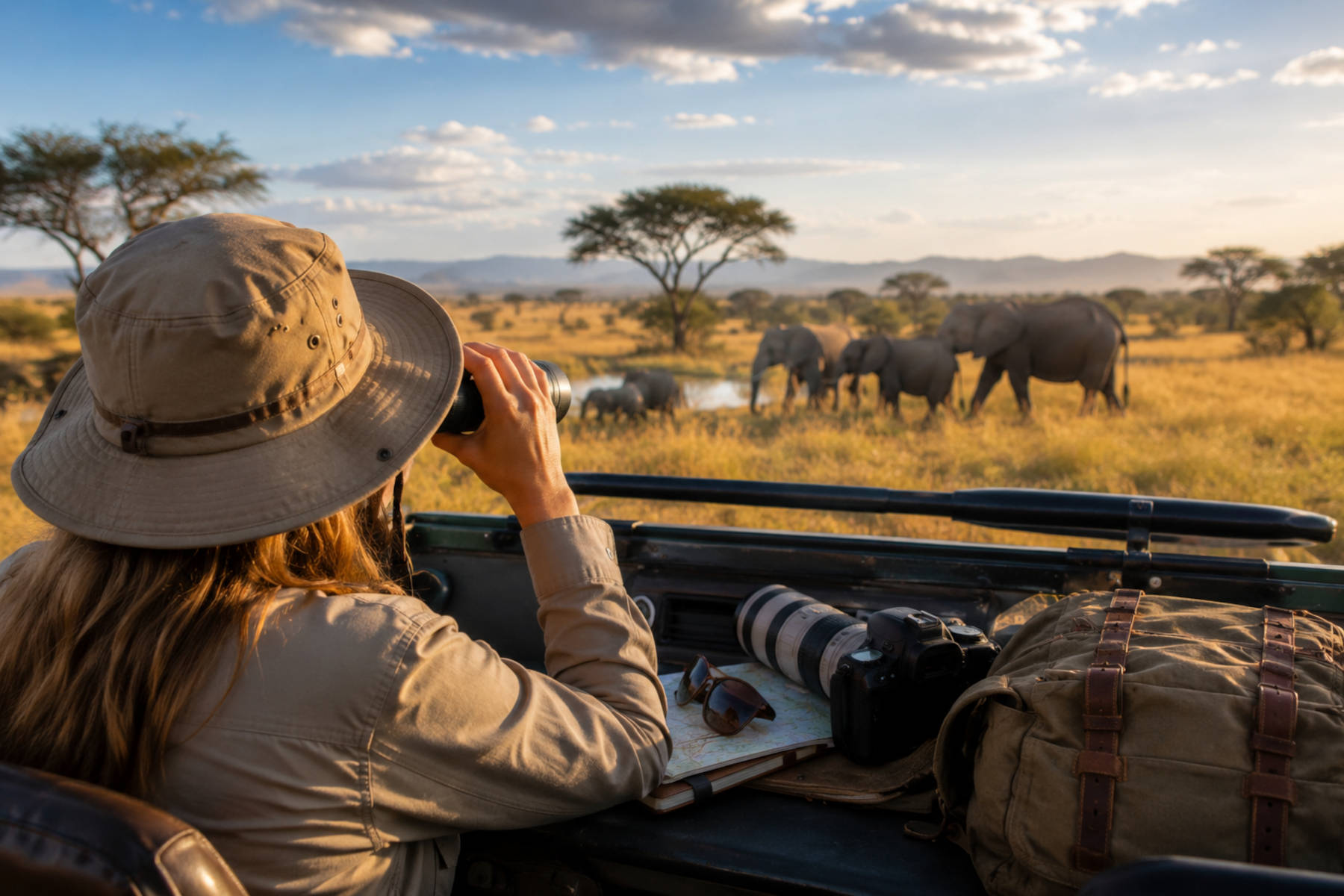
 A safari is one of those trips that can look deceptively simple when you see it in photographs. There is a vehicle, a guide, a few comfortable-looking people in neutral-colored clothes and, somewhere in the distance, an elephant, lion or giraffe waiting patiently to become the perfect picture. What those photographs rarely show is the practical side of getting there. Depending on the destination, your journey may involve several flights, rough roads, small aircraft, remote camps and strict luggage limits, all before you even reach the place where the wildlife begins.
That makes packing for a safari rather different from preparing for an ordinary holiday. You do not need a huge wardrobe, and you probably do not need to buy an entire collection of specialized outdoor equipment. What you do need is clothing that works in changing conditions, reliable protection from the sun and insects, comfortable footwear, a way to keep your electronics charged and enough practical gear to make long days outdoors comfortable. Above all, you need to understand the conditions of the particular safari you are joining.
A wildlife safari in Kenya or Tanzania is not necessarily the same experience as one in South Africa, Botswana, Namibia or Zambia. Some trips are based in comfortable lodges and use large vehicles, while others involve small bush planes, mobile camps or long periods away from any town. The climate can range from hot and dry to surprisingly cold in the early morning, particularly when you are sitting in an open vehicle before sunrise. The best packing list therefore starts not with a shopping catalogue, but with the itinerary.
This guide focuses on the things that genuinely matter when preparing for a safari, including clothing, binoculars, cameras, sun and insect protection, personal medication, electronics and luggage. It also looks at one of the least glamorous but most important parts of safari planning: weight. When a small aircraft is carrying you and your luggage into the bush, every unnecessary kilogram suddenly becomes much more important than it seemed when you were packing at home.
1. Start With the Safari You Are Actually Taking
Before choosing what to put in your suitcase, find out exactly how the trip will work. A safari can mean a short game drive from a permanent lodge, a week moving between several camps or a much more remote expedition where small aircraft are the only practical way to travel between locations. The difference affects almost everything you pack, from the type of luggage you use to how many changes of clothes you can realistically bring. Even two safaris in the same country can have completely different practical requirements.
Look carefully at the itinerary and pay particular attention to internal transfers. If your trip includes light aircraft, ask the operator about the exact luggage allowance, whether a soft-sided bag is required and whether there are restrictions on individual bag dimensions. These limits are not something you can negotiate at the airport simply because your suitcase happens to contain an expensive camera. A beautiful hard-shell suitcase may be perfectly sensible for an ordinary flight and completely inappropriate for a small bush plane.
The accommodation also matters. A luxury lodge with daily laundry service creates a very different packing problem from a remote mobile camp where you may be expected to carry everything you need for several days. Ask whether laundry is available, whether towels and basic toiletries are provided and what kind of electricity is available for charging equipment. A few minutes spent checking these details can eliminate a surprising amount of unnecessary luggage.
Finally, look at the season rather than relying on a generic image of Africa as permanently hot. Early morning game drives can be genuinely cold, especially when a vehicle is moving quickly through the darkness before sunrise, while afternoons may become extremely warm. Rainy seasons bring their own problems, including wet roads, humidity and insects, while dry seasons can mean dust and intense sunlight. Your packing list should respond to the actual conditions you are likely to encounter rather than to the safari stereotype.
2. Clothing: Light, Practical and Easy to Layer
Safari clothing has acquired a certain visual mythology. Neutral shirts, khaki trousers and wide-brimmed hats have become almost a uniform in travel photographs, but the practical reason behind this style is much more important than the appearance. You want clothing that is comfortable for sitting in a vehicle for several hours, protects you from the sun and insects, handles dust and can be layered as temperatures change. You do not need to dress like an explorer from a century-old movie.
Lightweight trousers and long-sleeved shirts are particularly versatile because they protect your skin without necessarily making you uncomfortable in warm weather. Breathable fabrics are useful during the hottest part of the day, while a lightweight fleece or sweater can make an enormous difference during an early morning drive. Instead of packing separate outfits for every possible temperature, build a small collection of layers that can be combined depending on the conditions. This saves both space and weight.
Neutral colors are generally a sensible choice, particularly for walking activities or situations where you are closer to wildlife than you would be from a safari vehicle. Beige, olive, brown and other subdued colors are practical and photograph well without turning the trip into a fashion exercise. Bright colors are not necessarily dangerous in every safari environment, but there is little reason to make yourself conspicuous when simple, muted clothing works just as well. More importantly, avoid choosing clothes solely because they look adventurous in photographs.
You should also expect your clothes to get dirty. Dust is part of many safari experiences, and an open vehicle can cover everything in a fine layer surprisingly quickly. That is another reason to favor comfortable, durable pieces that can be washed or worn repeatedly rather than delicate travel clothing. If laundry is available at your lodge or camp, a small wardrobe becomes much more practical than it initially appears.
3. Shoes Should Be Comfortable Before They Are Impressive
Footwear requirements depend heavily on the type of safari you are taking. If you will spend nearly all your time sitting in a vehicle and walking only short distances around the lodge, comfortable outdoor shoes may be all you need. A walking safari is a completely different proposition, because you may spend several hours moving over uneven ground in heat, dust or wet conditions. The important thing is to understand which experience you are actually booking before deciding that you need heavy hiking boots.
For many vehicle-based safaris, lightweight walking shoes or sturdy trainers are perfectly adequate. They are easier to pack, more comfortable around camp and much less cumbersome than large expedition boots. If your itinerary includes serious walking, however, footwear with better ankle support and a reliable sole may be appropriate. The terrain, weather and advice from the local operator should determine the choice rather than the idea that every safari requires military-style boots.
Whatever you bring, wear it before the trip. A safari is a particularly bad place to discover that your new boots rub your heels or that your shoes become uncomfortable after several hours. Even if you expect to spend most of the day in a vehicle, there will usually be some walking involved, whether around camp, at an airstrip or during organized excursions. A lightweight second pair can also be useful, particularly in warm weather when you want to give your main shoes a chance to dry and air out.
One final consideration is dust and mud. Footwear that looks immaculate when you leave home may look very different after a few days on safari, and that is perfectly normal. Choose something you can clean reasonably easily and do not bring your favorite expensive shoes simply because they happen to be comfortable. The bush is not the place to worry about keeping your footwear pristine.
4. Sun Protection Is Essential, Not Optional
One of the easiest mistakes on a safari is to underestimate the sun. Sitting in a vehicle can feel relaxing, particularly when a breeze is moving through the open sides, but you may spend many consecutive hours exposed to direct sunlight. The situation becomes even more demanding around midday, when the heat is strongest and there may be very little shade. Sunscreen, sunglasses and a good hat are therefore basic safari equipment rather than things to remember only if the forecast looks particularly hot.
A hat with a reasonable brim can protect your face, ears and neck far better than a simple baseball cap, although a cap is still better than nothing and may be more comfortable in some vehicles. Sunglasses should provide good UV protection and fit securely enough that they will not constantly move around when the vehicle is driving over rough ground. If you are bringing prescription glasses, consider what you will do if they are lost or damaged, particularly on a remote trip where replacing them may not be straightforward.
Sunscreen should be applied before the first game drive and reapplied during the day, especially after sweating. Do not forget areas that are easy to overlook, such as the back of your neck, ears and hands. Lightweight long-sleeved clothing is another useful layer of protection and can be more comfortable than repeatedly applying sunscreen to every exposed part of your body. On a long safari, preventing sunburn is considerably easier than trying to deal with it while continuing to spend several hours outdoors every day.
Lip balm with sun protection can also be surprisingly useful in dry climates, where wind and intense sunlight can leave your lips uncomfortable long before you realize what is happening. If your safari includes a lot of time in an open vehicle, a lightweight scarf or buff can provide additional protection from sun and dust. None of these items is particularly large or expensive, but together they can make a noticeable difference to how you feel at the end of a long day in the bush.
5. Insects, Personal Medication and a Sensible First-Aid Kit
Insects are one of the less glamorous realities of a safari, and the amount of attention they require depends strongly on where and when you are travelling. Mosquitoes may be a minor annoyance in one destination and a much more serious concern in another, while other insects can become particularly active around water or after sunset. Your operator should be able to explain the local conditions and any precautions they recommend. That advice is much more useful than assuming that every safari requires exactly the same insect protection.
A good insect repellent should be easy to reach during the day, rather than buried at the bottom of your luggage. Long sleeves and trousers provide an additional physical barrier, while evening clothing that covers more of the body can be especially useful around camps. If your accommodation uses mosquito nets or other protection, use them properly rather than assuming that a comfortable-looking room means insects are not a concern. In remote areas, small precautions are usually much easier than dealing with the consequences later.
Personal medication deserves careful planning because a safari may take you far away from a pharmacy. Bring enough of any regular medication for the entire journey and, where practical, keep a reserve in case of delays. It is also sensible to carry basic supplies for minor problems such as headaches, blisters, small cuts or stomach discomfort, although the exact contents of a personal medical kit should reflect your own needs and the destination. If you have specific medical requirements, discuss them with a qualified healthcare professional before travelling rather than relying on a generic packing list.
Keep important medication in your hand luggage rather than in checked baggage whenever possible. This is particularly important when your journey involves several flights or small aircraft, where luggage can occasionally be delayed or separated from its owner. Original packaging and any documentation you may need for prescription medicines can also make international travel considerably easier. A safari is supposed to take you away from everyday routines, but there are some routines that are much better maintained.
6. Binoculars: Perhaps the Best Thing You Can Bring
A camera may produce the photographs you bring home, but binoculars can transform the experience while you are actually on safari. Wildlife is not always standing conveniently beside the road waiting to be photographed, and some of the most interesting encounters involve animals that are distant, partially hidden or simply difficult to see with the naked eye. A good pair of binoculars allows you to observe details without constantly relying on the camera’s zoom. For many travelers, they become one of the most frequently used items in the entire bag.
You do not necessarily need the most expensive binoculars available. A compact, good-quality pair that you can hold comfortably for extended periods is often more useful than a heavy professional model that spends most of the trip inside your luggage. Magnification, field of view, brightness and weight all affect the experience, and there is no single specification that is perfect for every traveler. If possible, try binoculars before buying them and make sure you can use the controls naturally.
Binoculars are particularly valuable because they encourage you to look at wildlife without immediately thinking about photography. You may notice the behavior of a group of elephants, the details of a bird perched far away or movement in the grass that would be almost invisible to the naked eye. Your guide may also point out something that is too distant for an ordinary camera to capture comfortably. Sometimes the most memorable part of a sighting is not the photograph but the few minutes you spend simply watching what is happening.
Protect them from dust and moisture when they are not being used, especially in an open vehicle. A simple protective case or pouch is usually sufficient, provided it is easy to access when your guide suddenly points toward something interesting. Like your camera, binoculars should be ready before the action begins rather than buried underneath three layers of clothing and a toiletry bag.
7. Camera Gear: Bring What You Can Actually Use
Photography is often one of the biggest attractions of a safari, but it can also be one of the easiest ways to overpack. Once you start thinking about wildlife photography, it is tempting to bring a camera body, several lenses, a tripod, extra accessories and enough storage to document every leaf and bird you encounter. In reality, you will spend much of the day moving between sightings, getting in and out of vehicles and reacting quickly when an animal suddenly appears. Equipment that is too heavy or complicated can end up becoming a burden rather than an advantage.
A camera with a good telephoto lens is usually far more useful than a large collection of specialized lenses. Wildlife rarely follows the photographer’s plans, and the most interesting sightings can happen at a considerable distance from the vehicle. A versatile zoom lens can therefore be an excellent compromise between reach, flexibility and weight, particularly for travelers who are not professional photographers. If you already own a camera system that you know well, there is also a strong argument for taking the equipment you are comfortable using rather than buying something new immediately before the trip.
Extra batteries and memory cards deserve more attention than many travelers give them. You may take hundreds of photographs during a single game drive, especially when an animal is moving or behaving in an interesting way, and there may not be a convenient opportunity to charge your equipment immediately afterward. Keep spare batteries protected from heat and dust, and make sure you have enough storage for the entire journey. It is also worth thinking about how you will back up photographs, because losing several days of unique wildlife images to a damaged card is a particularly painful kind of travel mistake.
Do not automatically assume that a tripod will be useful. In a safari vehicle there may be little room for one, and the movement of the vehicle can make a traditional tripod awkward or impractical. A compact support, beanbag or other lightweight solution may be more appropriate depending on the vehicle and the type of photography you plan to do. The best camera setup for a safari is usually the one that allows you to react quickly without spending half the sighting changing equipment.
8. Power, Batteries and Electronics in the Bush
Modern safaris can involve a surprising amount of electronics. A phone is useful for communication, travel information and photography, while a camera, binoculars and perhaps a laptop or tablet may all need charging at some point. The problem is that electricity in remote camps does not always work like electricity at home. Some camps have reliable outlets in the room, others provide charging stations at particular times, and some rely on solar systems with limited capacity. Find out what to expect before you arrive rather than assuming that every room will have several convenient sockets beside the bed.
A compact power bank can be extremely useful, particularly during long transfers or days when you spend many hours away from camp. Choose one that is reliable and appropriate for air travel, and keep it accessible rather than burying it in checked luggage. Spare camera batteries can be equally important if you are photographing wildlife intensively. On a remote safari, a simple charging problem can quickly become a photography problem, so a little redundancy is worth the small amount of space it takes.
At the same time, resist the temptation to turn the safari into a mobile office. A laptop may be necessary for some travelers, but for most people it simply adds weight and another device to worry about. The whole point of spending several days in the bush is to pay attention to what is happening around you, and constantly checking screens can easily become a distraction. Bring the electronics that genuinely support the journey and leave the rest at home whenever you can.
Dust deserves special attention because it can get into places you would never expect. Keep cameras, lenses, phones and charging equipment protected when they are not being used, particularly during drives on unpaved roads. A small cleaning cloth and basic camera-cleaning supplies can be useful, but avoid constantly opening bags in dusty conditions unless you actually need something. On safari, keeping your equipment clean is often less about elaborate maintenance and more about preventing unnecessary exposure in the first place.
9. Luggage: Weight Can Matter More Than Space
For an ordinary holiday, packing too much is mostly an inconvenience. On safari, it can become a genuine logistical problem. Many itineraries include small aircraft that connect remote camps, and these planes have much stricter luggage limitations than commercial airliners. Weight limits can be surprisingly low, and operators may require soft-sided bags that can fit into restricted storage compartments. The suitcase that seemed perfectly reasonable when you packed it at home may therefore be completely unsuitable for the second half of your journey.
Check the exact baggage rules with your safari operator before you start packing. Ask not only about the total permitted weight but also about the maximum size and type of bag, because a large hard case may be impossible to load even if it technically weighs less than the allowance. If you are travelling with camera equipment, find out how the operator expects valuable electronics to be carried. Your camera may need to remain with you rather than being placed in the aircraft’s luggage compartment.
This is where packing cubes and careful organization can become genuinely useful. They allow you to separate clothing, electronics and personal items while making it easier to see exactly how much you are carrying. Choose lightweight luggage and avoid spending your allowance on the bag itself. Every kilogram saved on unnecessary packaging is a kilogram that can instead be used for something you actually need.
The easiest way to reduce safari luggage is surprisingly simple: pack fewer clothes. If your accommodation offers laundry, you may need only a handful of shirts, trousers and underwear for an entire week. Combine layers rather than bringing separate outfits for every possible temperature, and remember that safari clothing is designed to be practical rather than glamorous. Once you accept that dust and a little dirt are part of the experience, packing becomes considerably easier.
10. The Best Safari Packing List Is the One That Leaves Room for the Experience
There is always a temptation to prepare for a safari by buying more equipment. A better camera, another lens, a specialized jacket, a bigger pair of binoculars and yet another gadget can make preparation feel reassuring, but none of these things guarantees a better wildlife experience. The most valuable preparation is understanding the destination, the season, the itinerary and the practical limitations of the trip. Once you know those things, the packing list becomes much shorter and much more sensible.
For most travelers, a small collection of versatile clothing, comfortable footwear, sun and insect protection, binoculars, essential camera equipment and reliable power accessories will cover the majority of situations. Add your personal medication, important documents and whatever the operator specifically requires, then stop. If a safari involves walking, camping or unusually remote conditions, follow the operator’s instructions rather than trying to create your own expedition kit from a generic list.
Most importantly, remember that safari is not a photography competition or an exercise in owning the right equipment. You may spend an entire morning searching for wildlife and then suddenly find yourself watching a lion walking silently through the grass, a herd of elephants crossing the road or a bird you have never seen before appearing only for a few seconds. In those moments, the equipment matters far less than being ready, comfortable and able to pay attention.
Pack light, protect yourself from the environment and keep the things you genuinely need close at hand. Leave enough space in your luggage for the unexpected, because the best part of a safari is often something that could never have appeared on a packing list. Long after the clothes have been washed and the camera batteries have been recharged, it will be those unexpected encounters with wildlife and the landscape that you remember.
The luggage advice is probably the thing I wish I’d known before my first safari. We had a small plane between camps and suddenly the suitcase I’d packed for a “normal” vacation became a complete nightmare. I ended up repacking everything at the lodge. Soft-sided bag and fewer clothes really are the way to go.
I completely agree about the early morning drives. I went to Kenya expecting heat all the time and was absolutely freezing during our first drive before sunrise. A lightweight fleece takes up almost no space but makes a huge difference when you’re sitting in an open vehicle.
The sun protection section is spot on. You get so used to sitting in the vehicle and feeling a bit of wind that you forget you’re basically outside for hours. I came back from Tanzania with a very impressive sunburn on the back of my neck 😅. A proper hat and long sleeves are now non-negotiable for me.
I like that this guide doesn’t turn into a shopping list. Before my Botswana trip I was convinced I needed expensive hiking boots, three jackets and all kinds of “safari gear”. In the end I mostly wore comfortable walking shoes and the same few shirts over and over. Laundry and lightweight layers saved a lot of space.
The part about not bringing too much camera gear really made me smile. I took two lenses on safari and spent half the time trying to decide which one to use while everyone else was already watching the animal 😂. These days I would much rather have one versatile lens, spare batteries and just enjoy the moment. The unexpected sightings are what you remember anyway.