

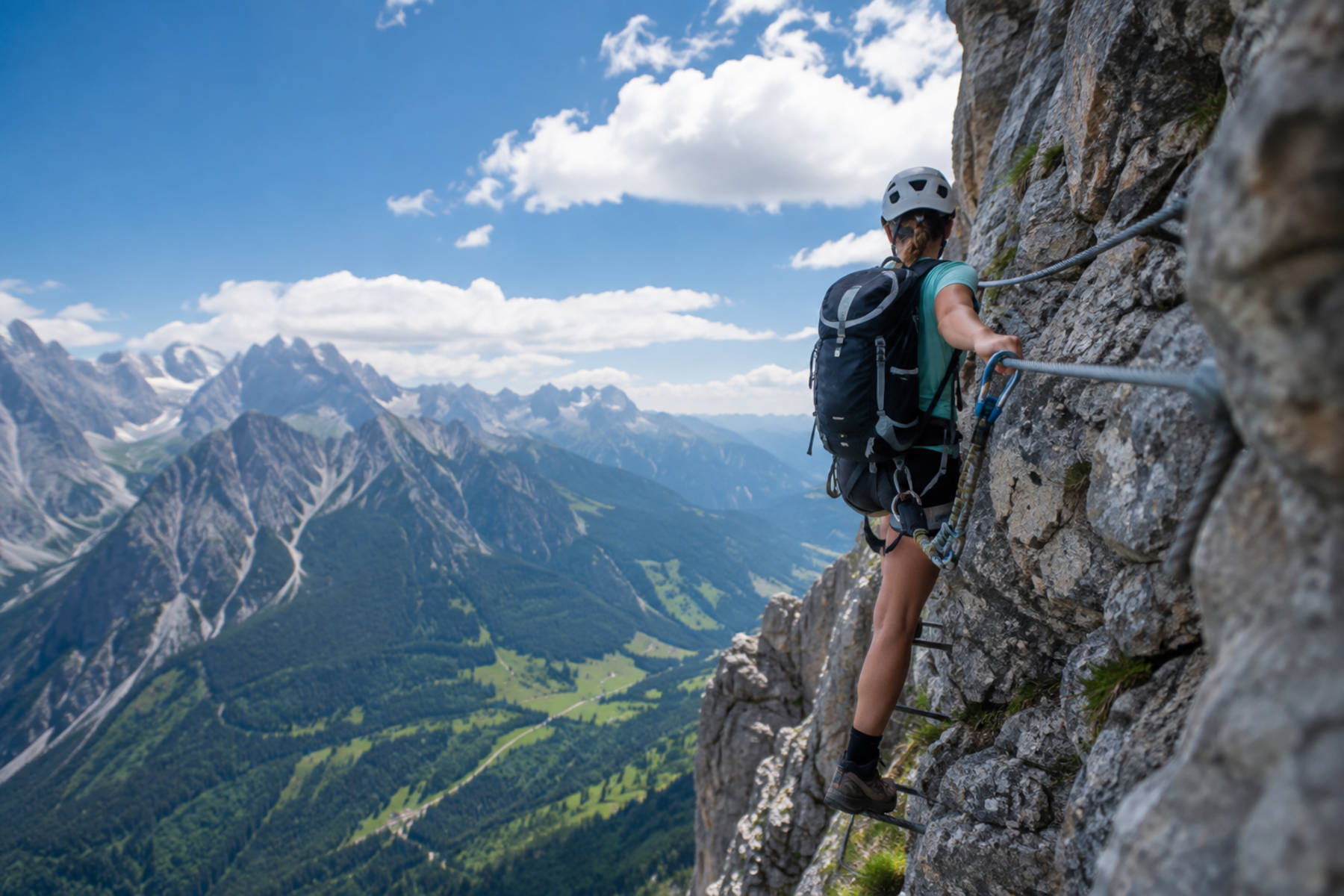
 If you have never heard the term via ferrata before, you are certainly not alone. The name comes from Italian and literally means “iron way”, which is a rather good description of what you will find in the mountains: routes equipped with fixed steel cables, metal rungs, steps, ladders and sometimes bridges that allow people to cross steep or exposed terrain. You clip yourself to the fixed cable with a specially designed safety system while using the rock and the installed metalwork to move upward, making it possible to experience terrain that would otherwise require considerably more climbing experience.
That description can make via ferrata sound almost like a mountain adventure park, but the reality is more interesting and considerably more serious. Some routes are short and relatively accessible, while others climb steep faces, cross exposed ridges and require a full day of mountain travel. The British Mountaineering Council points out that via ferrata routes range from straightforward roadside attractions to serious mountain adventures, and that even technically simple routes still require the right equipment and an understanding of how to use it. :contentReference[oaicite:1]{index=1}
For someone taking their first steps into the mountains, however, via ferrata can be an excellent introduction to a more vertical kind of adventure. You are not yet committing yourself to traditional rock climbing or mountaineering, but you can experience exposure, scrambling, steep terrain and the satisfaction of moving through a mountain landscape rather than simply walking around it. The important thing is to choose a route appropriate to your experience and, for a first attempt, strongly consider going with a qualified guide or experienced person who can teach you how the system works rather than simply handing you a harness and pointing toward the first ladder.
The equipment itself is not enormous, but several pieces are absolutely specific to the activity. A climbing helmet, harness and purpose-designed energy-absorbing via ferrata lanyard form the core of the safety system, while appropriate mountain clothing, footwear, gloves, water and navigation equipment make the rest of the day manageable. The most important lesson for a beginner is that via ferrata equipment is not something to improvise: an ordinary sling or piece of webbing is not a substitute for a purpose-designed energy-absorbing lanyard. :contentReference[oaicite:2]{index=2}
1. Understand the Route Before You Pack
The first thing to put in your backpack is information about the route. “Via ferrata” describes a type of mountain route, not a single level of difficulty, and the difference between two routes carrying the same name can be enormous. One may be a relatively short outing that combines hiking with a few protected rock sections, while another can involve sustained steep climbing, significant exposure, long approaches and demanding descents. Before deciding what equipment to take, find out exactly what you are going to climb.
Look at the route length, elevation gain, expected duration and difficulty, but do not stop at the technical grade. You also need to know how you get to the start of the ferrata and, perhaps more importantly, how you get off it. A route that looks short on a map can turn into a long mountain day once the approach, ascent, descent and return journey are included. Weather, altitude, exposure and the condition of the mountain can also change the character of the same route dramatically.
For a first experience, resist the temptation to choose the most spectacular route you can find simply because the photographs look impressive. The whole point of your first via ferrata should be to learn how the system works, become comfortable moving on steep terrain and discover whether you actually enjoy being attached to a mountain wall several hundred metres above the valley. Starting with an easier route gives you the opportunity to concentrate on technique and surroundings instead of spending the entire day fighting fatigue or fear.
It is also worth asking who will be responsible for the technical equipment. Many guided via ferrata experiences provide a helmet, harness and via ferrata set, which makes far more sense for a first attempt than buying everything before you know whether this is an activity you want to pursue. If you are renting equipment, make sure the guide or rental provider explains how it fits and how the system is intended to be used. The equipment may look simple, but understanding what each part does is considerably more important than knowing the brand name printed on it.
2. The Three Pieces of Equipment That Matter Most
For a beginner, the central piece of via ferrata equipment is the energy-absorbing lanyard, often called a via ferrata set. It connects your harness to the fixed steel cable and normally has two arms with purpose-designed K-type carabiners, allowing you to remain connected while moving from one section of cable to another. The energy absorber is not a decorative extra: it is specifically designed to reduce the forces generated in a fall. The British Mountaineering Council explicitly warns against using ordinary slings or improvised systems for this purpose because the forces involved in a via ferrata fall can be extremely high. :contentReference[oaicite:3]{index=3}
The harness provides the connection between your body and the lanyard, and it needs to fit properly rather than simply being tightened until it feels secure. A standard climbing sit harness is commonly used, although full-body harnesses can have advantages in some situations, particularly for children or when a backpack could affect the position of the body during a fall. If you are renting a harness, take the time to adjust it correctly before leaving the ground and ask the guide to check it. A few minutes spent getting the fit right is far preferable to discovering an uncomfortable or badly adjusted harness halfway up a route.
The helmet is the third essential component. Falling rock is one obvious reason to wear one, but there are also plenty of opportunities to hit your head against the mountain itself when moving through steep terrain, ladders or overhanging sections. A proper climbing or mountaineering helmet should fit securely and remain comfortable for the entire route. This is not the place for a bicycle helmet or a generic outdoor helmet simply because it happens to be sitting in your garage.
These three items work as a system, and that is why buying or assembling individual pieces without understanding how they interact is a poor approach for a first-timer. The lanyard needs to be compatible with the harness and designed specifically for via ferrata use, while the carabiners on the lanyard are not ordinary climbing carabiners. Modern via ferrata sets use K-type carabiners designed for the particular demands of the fixed-cable system, and the equipment should be used according to the manufacturer’s instructions. :contentReference[oaicite:4]{index=4}
3. Gloves, Shoes and the Clothes That Actually Work
Once the safety system is sorted, the rest of your clothing should be chosen with one simple idea in mind: you are going to spend several hours moving through a mountain environment, not posing beside a dramatic piece of rock. Gloves are particularly useful because your hands may spend a great deal of time gripping metal cables, rungs and rough rock. A pair designed for via ferrata or light climbing can protect your palms while still allowing enough dexterity to operate the carabiners correctly. Avoid anything so bulky that you struggle to manipulate the safety system.
Footwear requires a similar balance between climbing ability and ordinary mountain walking. You need enough grip and stability for rocky terrain, but extremely heavy mountaineering boots may be unnecessary on an easier summer ferrata. Approach shoes or sturdy hiking footwear can work very well on many routes, particularly when the day includes a long approach and descent, although the terrain and conditions should ultimately determine the choice. The BMC notes that approach shoes can be advantageous for moving on the ferrata itself, while more substantial boots may be preferable when the route involves long scree descents or more demanding mountain terrain. :contentReference[oaicite:5]{index=5}
Clothing should follow the same principle of flexibility we use for any mountain activity. A lightweight base layer, an insulating layer and a waterproof outer shell allow you to adapt when the temperature changes, which it can do quickly as you gain elevation. Even on a warm summer morning in the valley, the exposed upper sections of a route can be windy, cold or wet. A compact waterproof jacket and a warm layer therefore deserve space in your backpack even when the forecast looks reassuring.
Do not forget that the approach and the descent may be as important as the ferrata itself. You may spend an hour or more walking uphill before you even reach the first cable, and then discover that the route finishes far from where you started. This is another reason not to choose clothing or footwear purely for the technical climbing sections. Good via ferrata equipment should disappear into the background while you are moving, leaving you free to concentrate on the mountain rather than on your own clothes and gear.
4. What Goes Into Your Backpack
A via ferrata backpack should be small enough not to interfere with your movement but large enough to carry the things you may genuinely need during a full mountain day. Around 15 to 25 litres is often plenty for a straightforward day route, although the ideal size depends on the season, the length of the approach and how much clothing you need to carry. A large expedition pack can become surprisingly annoying when you are climbing ladders, squeezing through narrow sections or leaning back from the rock. The less unnecessary weight you carry, the more enjoyable the route is likely to be.
Water should be at the top of the list. Climbing fixed cables and ladders may not look like strenuous exercise from the photographs, but moving vertically over several hours can be surprisingly demanding, particularly in warm weather. Carry enough water for the entire outing and remember that there may be no opportunity to refill once you are on the route. A hydration bladder can be convenient, although some people prefer bottles because they are easier to monitor and refill.
Food should be equally straightforward. You do not need a complicated mountain picnic, but you should have enough energy for the approach, the ferrata itself and the return journey. Sandwiches, fruit, energy bars, nuts or other compact foods that you already know you tolerate well are usually more useful than anything elaborate. It is better to carry a little more food than you expect to need, particularly when the weather or your pace could turn a planned three-hour outing into a much longer day.
A lightweight waterproof jacket, a warm layer, a small first-aid kit, sunscreen, sunglasses and a headlamp are sensible additions even on a relatively easy route. A phone should be carried securely rather than loosely in a pocket, and a power bank can be useful on a longer outing. The important thing is to organize the backpack so that essential items can be reached without emptying everything onto a rock ledge. You should be able to find your water, jacket or first-aid supplies quickly while keeping the rest of your equipment safely stowed.
5. Weather Is Part of the Equipment
Mountain weather deserves considerably more respect than a casual look at the forecast for the nearest town. A via ferrata often takes you higher and into more exposed terrain than you may initially expect, and conditions can change rapidly with altitude. Wind, rain, thunderstorms, fog and sudden temperature drops can transform a pleasant route into a genuinely unpleasant or dangerous outing. Before leaving, check a mountain-specific forecast and pay particular attention to thunderstorms if the route involves exposed ridges, summits or extensive metal cables.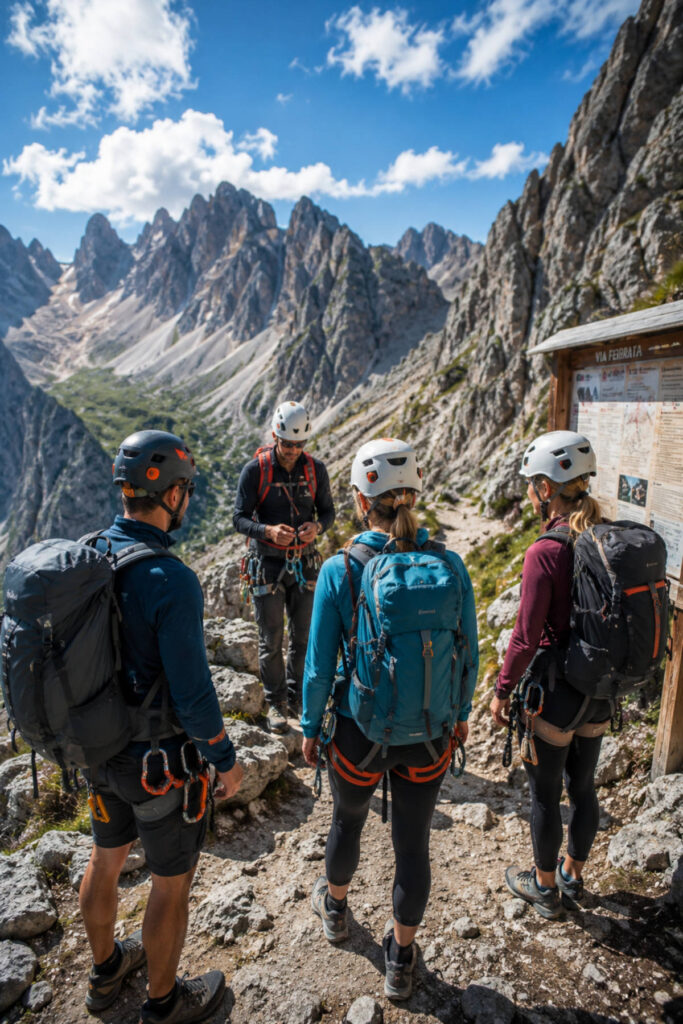
Rain creates more than a simple problem of getting wet. Rock becomes slippery, metal rungs can be difficult to grip and visibility may deteriorate rapidly. If the route involves significant exposure, retreating can also be more complicated than it appears from the ground. This is why a waterproof shell belongs in the backpack even when the morning begins under completely clear skies. A weather forecast is useful information, but it is not a guarantee that conditions will remain unchanged for the entire route.
Thunderstorms deserve special attention because a via ferrata contains a long continuous network of exposed metal equipment. Being attached to a steel cable on an exposed mountain during a storm is obviously not a situation you want to find yourself in. If thunderstorms are forecast, the sensible response is often to postpone the outing or choose a lower and less exposed activity rather than hoping the storm will arrive later than predicted. Experienced guides take weather seriously for precisely this reason.
The same principle applies to heat. A route that feels comfortable early in the morning can become exhausting when the sun reaches a south-facing rock wall several hours later. Carry sufficient water, protect your skin and choose the timing of the ascent carefully when possible. On a hot day, starting early can make the difference between an enjoyable mountain experience and several hours of unnecessary suffering.
6. Learn How to Use the Safety System Before You Climb
Having the correct equipment is only the beginning. A via ferrata set is designed to protect you when you fall, but that does not mean that falling is something you should regard as a normal part of the activity. The safest approach is to remain stable, move deliberately and keep the safety system connected correctly throughout the route. Before your first climb, learn exactly how the two carabiners are transferred past the anchors and practice the movement somewhere safe while a qualified person checks what you are doing.
The basic principle is simple: when you reach an anchor point in the steel cable, one carabiner is moved beyond the obstacle while the other remains connected, and then the second follows. You should never deliberately disconnect both carabiners from the cable at the same time. It sounds obvious when explained on the ground, but people can become distracted when they are tired, exposed or trying to move quickly around an awkward section of rock. Practising the procedure until it becomes automatic is therefore much more valuable than simply reading instructions once.
Distance from other people matters as well. A fall on a via ferrata can generate significant forces, and being too close to another person can create additional hazards if someone slips or loses their footing. The route may also contain fixed anchors, ladders and narrow sections where overtaking is difficult or impossible. A calm pace and reasonable spacing make the experience more comfortable for everyone and reduce the temptation to rush because another group is immediately behind you.
For a first experience, this is one of the strongest arguments for going with a qualified guide. A guide can explain the equipment, demonstrate safe movement and, perhaps most importantly, help you understand the difference between a challenge that is within your ability and one that is becoming too much. You are not there to prove anything to the mountain. If you are frightened, exhausted or uncomfortable with the exposure, saying so is not failure; it is simply useful information that should influence what happens next.
7. Navigation, Communication and the Things You Hope Not to Need
Even on a well-marked via ferrata, navigation should not be treated as someone else’s responsibility. Mountain routes can be confusing at junctions, particularly when several trails share the same approach or descent, and weather can make familiar terrain look completely different. A smartphone with an offline map is an excellent backup, but it should not be your only plan, especially if the route takes you into an area with unreliable mobile coverage. Before setting out, make sure you know where the route starts, where it finishes and what the possible escape routes are.
A charged phone belongs in your backpack, but it should be protected from both weather and accidental drops. If you are using it for navigation, download the relevant maps before leaving an area with a reliable internet connection. A small power bank can be useful on a long day, particularly if you are also taking photographs or using GPS continuously. In remote mountain areas, however, a phone should be considered a useful tool rather than a guarantee that you will always be able to call for help.
A headlamp is another small piece of equipment that is easy to dismiss until you actually need one. The route may be planned to finish well before sunset, but delays are common in the mountains, especially when a group moves more slowly than expected or weather forces a change of plan. Discovering that the final descent will take place in darkness is a very different experience when everyone has a proper light rather than trying to illuminate the trail with a phone. For such a small object, a headlamp provides an enormous amount of useful insurance.
It is also worth leaving your itinerary with someone who is not on the route. Tell them where you are going, which route you intend to take and approximately when you expect to return, particularly if you are travelling independently. On a guided trip, the operator will normally have its own procedures for emergencies, but that does not make basic personal preparation unnecessary. Mountains reward self-reliance, but sensible self-reliance begins with understanding when you should rely on someone else’s experience.
8. What You Probably Should Not Take
One of the easiest ways to make a via ferrata harder than it needs to be is to bring too much equipment. A large backpack, unnecessary climbing hardware and heavy clothing may seem reassuring when you are standing in the valley, but every extra kilogram becomes noticeable once you are climbing ladders or moving across exposed rock. The objective is not to recreate an expedition shop inside your backpack. It is to carry the equipment that is appropriate for the route and leave everything else behind.
In particular, beginners sometimes assume that they need a collection of climbing equipment because the route looks like rock climbing. On a properly equipped via ferrata, the fixed cable and installed hardware are already part of the route, and the equipment you need for personal protection is much more specific. Unless a qualified guide or the route operator tells you otherwise, there is little reason to carry a large collection of ropes, slings and climbing hardware simply because you own them. Extra equipment is not automatically extra safety.
The same applies to clothing. You do not need three jackets because the weather forecast contains the word “mountain”, nor do you need a huge backpack filled with emergency equipment for a short, straightforward summer route. A waterproof shell, a warm layer and sensible protection against the conditions are usually far more useful than a wardrobe. The exact balance should always reflect the route, season and local advice rather than a generic idea of what a mountain adventurer is supposed to carry.
There is also something to be said for leaving distractions behind. A camera can be wonderful on a via ferrata, and the views can be spectacular, but equipment should never interfere with safe movement. Anything that hangs loosely from the harness or backpack can catch on rock, ladders or cables, while constantly stopping to take photographs can disrupt your rhythm and the people moving behind you. Take photographs when the terrain allows it, but remember that the mountain deserves your attention more than your social media feed does.
9. Renting Gear Is Often the Smartest Choice for Your First Via Ferrata
If this is your first via ferrata, there is little reason to rush out and buy an entire set of specialist equipment. The helmet, harness and via ferrata lanyard are not particularly useful outside activities that require similar equipment, and you may discover after one day that vertical mountain routes are simply not your thing. Renting a properly maintained set from a reputable provider or using equipment supplied by a qualified guide allows you to try the activity without making a substantial investment before you understand what you need.
There is another advantage to renting locally: the equipment can be appropriate for the particular route. Guides and specialist rental companies know what is commonly used in the area and can help you select the correct size and configuration. They can also inspect the equipment before handing it over and explain how it works. For a beginner, that practical instruction is considerably more valuable than choosing equipment from an online catalogue based on photographs and product descriptions.
If you decide that via ferrata is something you want to pursue regularly, buying your own equipment can eventually make sense. At that point, you will already have experience with different harnesses, helmets and lanyards and will have a much better idea of what feels comfortable to you. You will also understand the importance of checking equipment condition and following the manufacturer’s instructions for inspection and replacement. Safety equipment is not the place to save money by buying questionable second-hand gear simply because it looks almost new.
For your first few routes, however, spend your money on the experience rather than the equipment. A good guide, an appropriate route and a properly fitted rental kit will teach you much more than owning the most expensive harness in the shop. If you fall in love with the activity, there will be plenty of time later to build your own setup based on real experience rather than guesswork.
10. The Mountain Is More Important Than the Equipment
Via ferrata occupies an interesting place between hiking, scrambling, climbing and mountaineering. That is precisely what makes it attractive to people who want to experience steeper and more exposed mountain terrain without immediately committing themselves to traditional climbing. But the presence of a steel cable should never create a false sense of security. The route remains a mountain environment, and weather, rockfall, exposure, fatigue and poor decisions can all create genuine danger.
The best preparation is therefore a combination of suitable equipment, an appropriate route and an honest assessment of your own abilities. Choose something within your experience, check the conditions, start early enough to avoid unnecessary pressure and listen to local advice. If the weather deteriorates or you discover that the route is beyond your comfort level, turning around is always a perfectly legitimate outcome. The mountain will still be there another day.
For a first adventure, keep the equipment simple and reliable: a properly fitted climbing helmet, harness and purpose-designed via ferrata set, comfortable mountain footwear, gloves, suitable layers, enough food and water, navigation and basic emergency essentials. Everything else should support those fundamentals rather than compete with them. Once you have completed a few routes, you will quickly discover which pieces of equipment genuinely improve your experience and which ones were never necessary in the first place.
And perhaps that is the most appealing thing about via ferrata. You do not need to become an alpinist overnight to experience a very different side of the mountains. With the right route, sensible preparation and proper safety equipment, you can climb above the ordinary hiking trails, cross rock faces, follow old mountain passages and discover landscapes that cannot be reached simply by walking along a road. The equipment gets you there, but the mountain itself is what you will remember.