

 Scuba diving is one of those activities that can look deceptively simple from the surface. Put on a mask, strap on a tank, jump into the water and discover another world beneath the waves. The reality is considerably more serious. Underwater, the familiar rules of everyday life change. You cannot simply stop and take a breath. Your equipment becomes part of your ability to remain in the environment. Visibility can change, conditions can deteriorate, and mistakes that would be insignificant on a hiking trail can have very different consequences below the surface.
I know this not only from reading about diving. I completed an Open Water course myself, including training in a dry suit during winter in the Moscow region, with snow and freezing temperatures above the water. It was an interesting experience, and one I am glad to have had. But it also taught me something important: diving is not necessarily the right activity for everyone. In my case, cold-water diving simply did not become something I wanted to continue.
That is why I would approach a diving trip rather differently from a camping weekend or a cycling holiday. There is no reason to rush out and buy a complete set of scuba equipment after your first introductory dive. Before spending serious money, it makes much more sense to complete proper training, make several dives and find out whether you genuinely enjoy being underwater.
Once diving becomes a regular part of your life, owning your own equipment can make perfect sense. A well-fitting mask, a familiar wetsuit, a dive computer and eventually other personal equipment can make diving more comfortable and predictable. But tanks and weights are normally provided or rented locally, and there is little practical reason to transport them around the world yourself.
This guide is therefore not a shopping list designed to convince a beginner to buy everything in sight. It is about understanding what you actually need to take on a diving trip, what is usually better rented at your destination, what belongs in your luggage, and what is more important than any piece of equipment you can buy. Because in diving, the most important things you bring with you are not always found in a gear bag.
1. Before You Pack Anything, Decide What Kind of Dive Trip You Are Taking
The first mistake is to start packing before you know what kind of diving you are actually going to do.
A tropical holiday with a local dive center is one thing. A week on a liveaboard is another. Shore diving, boat diving, warm-water reefs and cold-water diving can all require very different equipment and clothing. Even two dive centers operating in the same country may provide different rental equipment or have different expectations for their guests.
Before leaving home, find out exactly what your operator provides and what you are expected to bring. Ask about the equipment available for rental, the type of exposure protection required, the expected water temperature, the number and type of dives, and whether there are any special requirements for the sites you will visit. This simple conversation can save you from carrying half a dive shop through an airport.
It is also worth considering your own level of training and experience. A recreational diver going on a guided holiday should not approach the trip in the same way as someone with advanced training preparing for more demanding diving. Your equipment, your plans and your expectations should all match your actual experience.
There is nothing disappointing about choosing an easier dive site. In fact, knowing your limits is one of the things that makes diving enjoyable. The ocean does not care how ambitious your holiday itinerary looked when you booked it.
Weather and sea conditions deserve the same respect. A dive trip may have been planned months in advance, but conditions can change in a matter of hours. A responsible operator may cancel or modify a dive when conditions are unsuitable. That is not a failure of the trip. It is part of diving. The best preparation, therefore, begins with accepting that the plan may change.
2. Don’t Buy a Full Set of Equipment Before You Know You Love Diving
Scuba diving has an impressive ability to make beginners believe that they need a garage full of equipment. Mask. Fins. Wetsuit. BCD. Regulator. Computer. Boots. Hood. Gloves. Surface marker buoy. Lights. Bags. Accessories. Before long, a person who has made a handful of dives can find themselves browsing equipment catalogs and wondering which regulator would be appropriate for an expedition they have not even planned.
There is nothing wrong with eventually owning good equipment. But there is a very good reason not to rush. First, you need to discover whether diving is actually for you. The experience underwater is very different from watching diving videos or looking at photographs of coral reefs. Some people love the sensation of weightlessness and the quiet world beneath the surface. Others find the restricted breathing, mask, equipment and sensation of being underwater uncomfortable. Neither reaction is wrong.
I would therefore recommend treating your first dives as an opportunity to learn about yourself as much as about diving. Complete the appropriate training, dive with qualified professionals, and give yourself enough time to decide whether you want this to become a regular activity.For many recreational divers, renting equipment is perfectly reasonable, particularly when traveling. A reputable dive center can provide tanks, weights and much of the standard equipment required for a dive. It also means you do not have to transport heavy and bulky equipment through airports, hotels and boats.
There are, however, some pieces of equipment that many divers eventually prefer to own because personal fit and familiarity matter. A mask is an obvious example. Once you find one that fits your face properly and does not constantly leak, you may never want to exchange it for a rental mask again.
The same principle can apply to a wetsuit, dive computer, regulator and other personal equipment as your experience grows. The important word is eventually. Buy equipment because you have discovered what you need, not because a glossy catalog has convinced you that you cannot go diving without it. And remember one particularly practical rule: tanks and weights are normally part of the local diving operation. Their type, configuration and amount depend on the dive and the operator, so carrying them halfway around the world makes little sense.
3. Your Mask Is More Personal Than Most of Your Dive Gear
If there is one piece of diving equipment that makes particular sense to own relatively early, it is the mask.
That may sound like a small detail, but a poorly fitting mask can turn an otherwise enjoyable dive into a constant battle with water. You clear it, adjust the strap, dive a little farther, and discover that it is leaking again. After several minutes of this, you stop looking at the reef and start thinking about the mask.
A good mask should fit your face properly and feel comfortable before you even enter the water. This is one reason buying a mask online simply because it looks good in a photograph is not always a great idea. Different faces require different shapes, and a mask that fits one diver perfectly may be completely wrong for another.
Fins are somewhat different. Rental fins are perfectly adequate for many recreational dives, and there is no urgent reason for a beginner to own a pair. Once you start diving regularly, however, your own fins can become worthwhile, particularly if you have discovered which style works best for you.
The same applies to smaller personal items such as a snorkel, boots, gloves or a hood. Whether you need them depends heavily on the type of diving and the water temperature. In warm tropical water, some of these items may be unnecessary. In colder conditions, they can become essential parts of your exposure protection.
The important thing is not to build a collection of equipment simply because experienced divers have one. Build your own setup gradually as your experience tells you what you actually need.
4. Exposure Protection: Don’t Guess the Water Temperature
Photographs of tropical diving can create a slightly misleading impression. A diver floating over a coral reef in bright sunshine looks as though the entire experience should be warm and effortless.
Water has other ideas. Even relatively warm water can become uncomfortable during a long dive, and repeated dives throughout the day can make the cold progressively more noticeable. In colder destinations, proper exposure protection becomes even more important. The right wetsuit, dry suit, hood, gloves and boots are not fashion choices. They are part of your ability to remain comfortable and focused underwater.
This is another reason to check the conditions at your destination before packing. Do not choose a wetsuit simply because somebody online said that a certain thickness is suitable for a particular country. Water temperature, duration of the dive, your own sensitivity to cold, the type of diving and the equipment available locally all matter.
I learned this lesson during my own Open Water training in the Moscow region, where I experienced dry-suit diving in winter conditions. It was a very different world from the warm-water images that most people associate with recreational diving. The cold was not something that could simply be ignored. It became part of the planning, the equipment and the entire experience.
For a beginner traveling to a warm-water destination, renting a wetsuit locally can be a perfectly sensible option. Dive centers know the conditions in their area and can usually recommend appropriate exposure protection. For a regular diver, however, owning a wetsuit can make more sense because fit matters and you already know what works for you.
Whatever you choose, do not treat thermal protection as an afterthought. Being cold underwater is distracting, uncomfortable and potentially exhausting. A diver who is comfortable can concentrate on the dive itself. A diver who is cold tends to think about getting out.
5. The Dive Computer Is Equipment You Should Understand, Not Just Wear
A dive computer can look like an ordinary wristwatch to somebody standing on a boat. For a diver, it is a very different kind of instrument. It provides information about the dive profile and helps the diver manage the dive within the limits of their training and plan. If you eventually decide to own one, the most important thing is not to choose the device with the longest list of features. Choose one you understand and know how to use.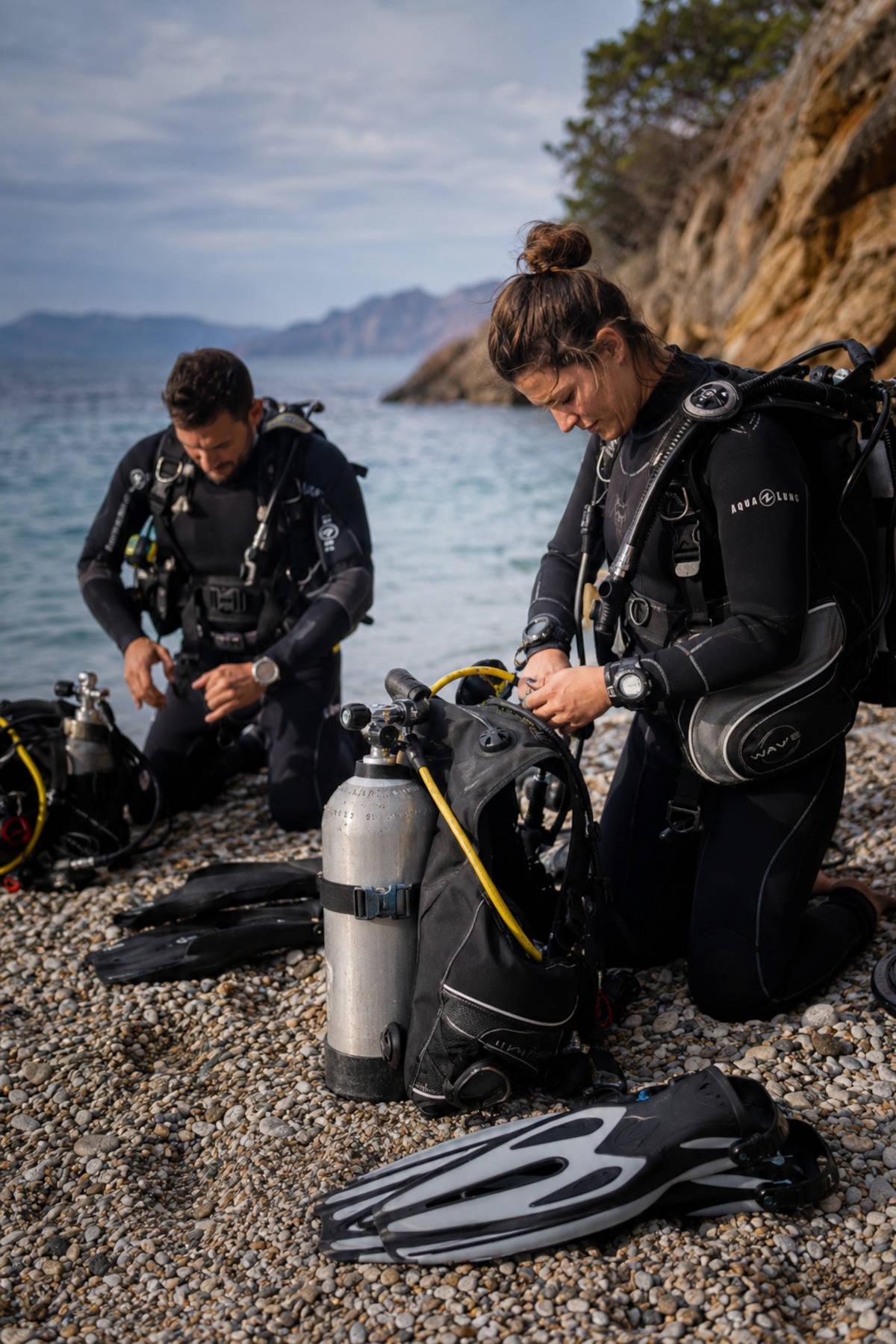
That principle applies to all diving equipment, but it is particularly important with instruments. Technology does not replace training or judgment. A computer can display information, but it cannot decide whether you are fit to dive, whether the conditions are suitable, or whether continuing a dive is a sensible decision.
If you use a rental computer, take the time to understand its basic functions before entering the water. Different models may present information differently, and familiarity is valuable when you are underwater.
The same cautious approach applies if you travel with your own regulator, BCD or other major equipment. Make sure everything has been properly serviced according to the manufacturer’s recommendations and that you are familiar with the configuration before the trip. There is no advantage in discovering how unfamiliar equipment behaves for the first time at depth.
Good diving equipment should gradually become almost boring. You know where everything is, how it feels, and what to do when something needs attention. The less mental energy you spend wondering whether your equipment will work, the more attention you can give to the actual dive.
6. The Small Things That Can Save a Dive
Experienced divers tend to accumulate a collection of small, inexpensive things that beginners rarely think about. None of them is particularly impressive. Most would never appear in a photograph of a perfectly equipped diver. Yet when something goes wrong, these little items can suddenly become the most valuable things in the bag.
A few spare mask straps, replacement batteries for equipment that uses them, O-rings, simple clips, cable ties, a small multitool and other compatible spare parts can take up very little room. Together, they form what divers sometimes call a “save-a-dive kit” — a small collection of items intended to deal with minor equipment problems before they become a reason to cancel a dive.
You do not need to carry a complete workshop. The idea is simply to be prepared for small, predictable problems. A broken strap is annoying. A missing O-ring can be enough to create a leak. A tiny piece of equipment that costs almost nothing can occasionally save an entire morning.
The exact contents depend on the equipment you own and the type of diving you do. If you rent most of your gear, there is even less reason to carry a large repair kit. The dive operator should be responsible for maintaining its rental equipment. But having a few personal essentials is still sensible.
There is another item that deserves a place in almost every diver’s travel bag: a proper dry bag. Boats and dive boats are wet environments. Water gets everywhere, often in places you did not expect. A dry bag gives you somewhere safe to keep your phone, wallet, documents, spare clothes and other things that should remain dry. None of these objects is glamorous. That is precisely why they are useful.
7. What Should Go in Your Carry-On?
Flying to a diving destination creates another problem that has nothing to do with being underwater: deciding what absolutely must stay with you during the journey. Airline baggage rules vary, and you should always check the current requirements of the airline you are flying with. But as a general principle, anything small, expensive, fragile or difficult to replace deserves careful consideration before being placed in checked luggage.
A dive computer is an obvious example. So is a prescription mask, important personal medication, certification documents and other equipment that would be difficult to replace at your destination. If you own a regulator, some divers also prefer to keep it in their carry-on luggage because it is relatively compact and represents a significant investment. The same can apply to a camera or other delicate electronics.
At the same time, do not turn your carry-on into a miniature dive shop. Airline restrictions apply to batteries, liquids, sharp objects and other items, and different airlines and airports can interpret rules differently. Check the regulations before you travel rather than discovering them at the security checkpoint.
A sensible strategy is to imagine that your checked bag will arrive a day late. What would you need in order to survive and function? A change of clothes, essential medication, documents, basic toiletries and the most important personal diving items should be considered accordingly. That may sound overly cautious until you are standing beside a baggage carousel watching everyone else’s suitcases appear while yours does not.
8. Life Between the Dives Matters Too
A diving holiday is not spent underwater. This sounds obvious, but it is easy to forget when preparing for a trip. A typical day may involve an early breakfast, a boat ride, a dive, several hours on the surface, another dive, a long return journey and an evening spent somewhere completely different from where the day began.
That means ordinary travel items can be just as important as dive equipment. Quick-drying clothes are particularly useful. So are a lightweight towel, swimwear, sunglasses, sun protection and something warm enough to wear when the wind picks up on a boat. A simple change of dry clothes can feel remarkably luxurious after spending hours in wet equipment.
Hydration deserves attention too. Diving, sun, wind and physical activity can all contribute to dehydration, and being surrounded by water can create the strange illusion that you cannot possibly be thirsty. Bring enough drinking water for the day and follow the guidance of your dive operator.
Food can be surprisingly important as well. Some people prefer a substantial meal before diving, while others feel much better with something light. The sensible approach is to know how your own body reacts rather than experimenting with an enormous breakfast on the morning of an important dive.
And then there is the dry bag again. On a boat, it can become your personal little island of civilization: phone, towel, sunglasses, spare shirt, wallet and everything else you want to find dry when you return to the surface. Comfort between dives matters because diving is not a single event. A trip may involve several dives in one day, repeated over several days. Being cold, dehydrated, sunburned or exhausted can gradually turn what looked like an exciting holiday into hard work.
The best dive trips leave you tired in a good way. You should finish the day wanting to remember what you saw underwater, not simply wanting to collapse into bed.
9. What You Should Probably Leave at Home
There is a particular temptation when preparing for a diving trip: the feeling that more equipment must automatically mean more safety and more enjoyable dives. It doesn’t. A suitcase filled with every piece of diving equipment you have ever seen may make you feel prepared, but it can also make travel unnecessarily difficult. Heavy bags, complicated packing and equipment that you never actually use are not signs of experience. They are simply heavy bags.
If you are traveling to a well-established dive destination, find out what the local operator provides before deciding what to carry. There is little point in taking bulky equipment halfway around the world if a reputable dive center can provide it locally and maintain it properly. Tanks and weights are the obvious examples. They are normally part of the local operation, and their configuration depends on the dive, the operator and the diver. They are not something a recreational traveler needs to put into a suitcase.
The same principle can apply to other equipment. If you are still relatively new to diving, renting a BCD, regulator, wetsuit or fins can be entirely reasonable. It allows you to travel lighter while gaining experience with different equipment before deciding what you eventually want to own.
There are also ordinary travel items that are easy to overpack. Too many clothes, too many shoes, excessive toiletries and gadgets that seemed essential at home can quickly become dead weight. One useful habit is to separate your packing into three questions: what do I absolutely need, what can I rent, and what would simply be nice to have?
The first category goes into the bag without much discussion. The second depends on your destination and operator. The third deserves a little more skepticism. After all, the less time you spend worrying about your luggage, the more time you have to enjoy the reason you traveled in the first place.
10. The Most Important Thing to Take Diving Is a Clear Head
There is plenty of expensive equipment associated with scuba diving. Some of it is beautifully engineered, some of it is surprisingly simple, and much of it can make diving safer and more comfortable when it is properly selected, maintained and used.
But the most important things a diver brings into the water are not made of rubber, plastic or metal. They are training, experience, physical readiness, discipline and judgment. A dive should never become a test of courage. If you are tired, unwell, anxious, cold, poorly prepared or simply uncomfortable with the conditions, there is nothing wrong with deciding not to go. The sea will still be there another day.
This is perhaps one of the biggest differences between scuba diving and many other outdoor activities. On a hiking trail, you can often stop, sit down and decide what to do next. Underwater, your options are more limited. Your equipment matters, your training matters, and your decisions matter.
That does not make diving frightening. Quite the opposite. When you are properly trained, understand your equipment and dive within your experience and limitations, the underwater world can be extraordinarily calm and beautiful.
The key is to respect the environment rather than trying to conquer it. That is also why I would never recommend buying a complete set of scuba equipment simply because you are planning your first diving holiday. Start with proper training. Rent equipment from a reputable operator. Make several dives. Pay attention to how you feel underwater. Learn what equipment actually suits you.
If diving becomes something you genuinely love, there will be plenty of time to build your own equipment setup. By then, you will know which mask fits you properly, which wetsuit keeps you comfortable, and which dive computer feels intuitive rather than complicated. You will also understand the importance of reliable, well-maintained equipment and know what you actually need from it. That knowledge is far more valuable than buying an expensive collection of gear before you have enough experience to understand your own preferences.
Until then, don’t worry about owning everything. Take the things you really need. Rent the things that make sense to rent. Check your equipment, listen to your instructors and dive operators, respect the conditions, and never let a planned holiday become more important than your own judgment.
The real reward of a diving trip is not the equipment you bring home. It is the memory of what you saw beneath the surface — a world that most people pass above without ever knowing what is there.
The advice about not buying a complete set of gear after your first few dives is spot on. I made exactly that mistake with snorkeling and diving equipment. After a couple of trips I realized that half of what I bought wasn’t really useful for the kind of diving I actually do.
For me, the mask is the one thing I’d definitely recommend buying fairly early. Rental masks can be perfectly fine, but finding one that fits your face properly makes such a difference. Once you have a mask that doesn’t leak, you really don’t want to go back to trying random rental ones.
Exactly. A leaking mask is surprisingly distracting. You can have an amazing reef directly in front of you and still spend half the dive thinking about the water in your mask.
I particularly liked the section about exposure protection. People seem to associate diving with tropical water, but even warm water can feel pretty cold after a long dive. And if you’re doing several dives in a day, it really adds up.
I did a few dives in the Baltic and learned very quickly that being “tough enough” is not a substitute for proper thermal protection.
The carry-on advice is something I wish I’d read before my first diving holiday. My checked bag arrived a day late and, of course, it contained almost everything I needed. Now my dive computer, prescription mask and essential personal stuff stay with me.
That said, I agree with the article that you shouldn’t turn your carry-on into a dive shop. There has to be a reasonable middle ground.
The last section is probably the best part of the whole article. Diving can create this strange pressure to prove that you’re capable of doing a particular dive because you’ve traveled so far for it. But conditions change, and sometimes the sensible decision is simply to skip a dive.
I’d rather come home disappointed about missing one dive than spend the rest of the trip wishing I’d listened to my instincts.