

There is something wonderfully direct about traveling by kayak. You are close to the water, close to the landscape and responsible for almost every mile you cover, with nothing between you and the river, lake or sea except the hull beneath you. Unlike a road trip, there is no convenient place to stop and unpack a suitcase, and unlike hiking, there is no comfortable way to carry a large backpack once you are sitting in a narrow cockpit. Everything you bring has to earn its place, and everything that comes with you needs to have a sensible way of staying dry.
That is part of what makes kayaking so appealing, but it is also what makes packing for a paddling trip slightly different from preparing for most other outdoor adventures. A calm afternoon on a lake requires very different equipment from a multi-day sea-kayaking expedition or a descent through moving whitewater. Before deciding what goes into the boat, it is therefore important to understand what kind of kayaking trip you are actually planning and what equipment the operator, club or outfitter will provide.
This guide is primarily about recreational kayaking and longer paddling adventures rather than technical whitewater expeditions. If you are heading into difficult rapids, exposed coastal waters or remote areas, the recommendations of an experienced instructor or local outfitter should take priority over any general packing guide. For everyone else, the basic principle is surprisingly simple: take what keeps you safe, comfortable and reasonably independent, protect it from water, and leave everything else on shore.
1. Start by Understanding the Water
The first thing to pack for a kayaking trip is information about the place where you will actually be paddling. A kayak behaves very differently on a sheltered lake, a slow-moving river and an exposed stretch of coastline, and conditions that look harmless from the shore can become much more demanding once you are several kilometers from your starting point. Water temperature, wind, current, waves, distance from shore and the availability of places to land all influence what you should carry. The same bag that is perfectly sensible for a sunny afternoon on a quiet lake may be completely inadequate for a remote coastal journey.
Weather deserves particular attention because paddlers cannot simply decide to continue driving when conditions deteriorate. Wind can turn a pleasant paddle into hard physical work, while a sudden change in temperature can make wet clothing uncomfortable or even dangerous. Check the forecast before leaving, but also understand the local geography and how quickly conditions can change on the water. If you are unfamiliar with the area, local knowledge from an experienced paddler or reputable outfitter can be far more useful than a generic weather forecast.
The length of the trip changes the equation as well. A few hours on the water may require little more than appropriate clothing, drinking water and a small amount of personal equipment, while an overnight journey means that food, shelter, sleeping gear and spare clothing all have to find a place somewhere in the boat. Before packing for a multi-day trip, find out whether you will be carrying everything yourself or whether group equipment and supplies will be distributed among several kayaks. Space inside a kayak is limited enough without carrying equipment that somebody else has already agreed to transport.
2. The Kayak Is Not a Backpack
One of the first lessons a new paddler learns is that a kayak has a very different relationship with luggage than a car or hiking backpack does. Space is limited, access can be awkward and the weight of your equipment can affect how the boat sits in the water. Something that feels light while you are standing on the shore can become surprisingly inconvenient when you have to squeeze it through a small hatch or rearrange the entire load because one essential item is buried underneath everything else.
That makes packing order almost as important as the equipment itself. The things you may need during the day should be easy to reach, while equipment intended for the evening can remain deeper inside the boat. Clothing, sleeping gear and other items that absolutely must remain dry should be packed carefully before they ever reach the kayak, because once you are on the water there may be no convenient opportunity to repack everything properly.
Weight distribution matters too. A kayak that is badly loaded can become less stable and less pleasant to paddle, particularly in wind or waves, so heavy items should be positioned according to the recommendations for the particular boat rather than simply pushed into whatever space happens to be available. If you are renting a kayak, ask the outfitter how the storage compartments should be used and whether there are limits on what you can carry. A little preparation on shore is considerably easier than trying to solve a badly balanced boat in the middle of a lake.
This is also why kayaking tends to reward minimalism. The goal is not to reproduce your entire life inside the boat, but to carry a compact collection of things that work together. Once you have spent a few hours paddling, the difference between essential equipment and unnecessary baggage becomes very obvious, particularly when every extra kilogram has to be moved by your own arms.
3. Clothing Should Be Chosen for the Water, Not the Weather App
Choosing clothes for kayaking begins with accepting one simple fact: you are likely to get wet. Even on calm water, paddles drip, waves splash over the bow and getting in or out of a kayak usually involves at least some contact with the water. Cotton clothing can become heavy and uncomfortable once soaked, so quick-drying synthetic or technical fabrics are generally much more practical. What matters is not how the clothes feel when you leave home, but how they behave after several hours of wind, spray and moisture.
Layering gives you much more flexibility than trying to predict the perfect outfit before the trip begins. A lightweight base layer can be combined with an insulating layer when temperatures fall, while a windproof or waterproof outer layer can protect you when the weather changes. On warm days, clothing that covers the skin can also provide useful protection from the sun without requiring constant application of sunscreen. The right combination will depend heavily on the season and water temperature, which is why local advice is particularly valuable.
Cold water requires a more serious approach. Air temperature can be misleading because falling into cold water is a very different experience from standing beside it, and even a warm day can become dangerous if you remain wet for a prolonged period. Depending on the conditions, a wetsuit, drysuit or other appropriate thermal protection may be necessary, particularly for sea kayaking, cold rivers or remote trips where getting back to shore quickly is not guaranteed. This is one area where it is far better to follow experienced local guidance than to discover halfway through a trip that your clothing was designed for the weather rather than the water.
Finally, remember that your clothing is part of your safety system rather than simply something you wear for comfort. A warm, dry layer sealed inside your waterproof storage can become extremely valuable after an unexpected swim or a long period of exposure to wind. Good paddling clothing does not need to look impressive, and it certainly does not need to be the most expensive gear in the shop; it simply needs to keep you functional when conditions stop being ideal.
4. Protect Everything That Must Stay Dry
Waterproof storage is one of those things that seems slightly excessive until the first time a kayak tips, a wave breaks over the deck or several hours of spray find their way into places you thought were protected. A kayak is surrounded by water all day, so even a carefully packed bag should never be treated as automatically waterproof simply because it sits inside a storage compartment. Dry bags, waterproof cases and properly sealed containers give your important belongings a second line of defense and make the whole trip considerably less stressful.
The things that absolutely need to remain dry deserve the most attention. Spare clothing, sleeping gear, medication, food and anything electronic should have a secure place where water cannot easily reach them, while particularly important items can be given additional protection inside smaller waterproof bags. Your phone may be useful for navigation, communication and photography, but it should not spend the day loose in a pocket where a single unexpected splash can ruin it. On a longer trip, losing your dry clothes or sleeping bag to water can be far more serious than losing an expensive gadget.
There is also an art to organizing dry storage. Packing everything into one enormous waterproof bag may seem efficient at home, but it becomes inconvenient when you need one small item and have to unpack half the contents of the kayak to find it. Smaller bags organized by purpose are often much easier to manage, particularly when one contains clothing, another holds personal items and another is reserved for food or equipment. The exact system does not matter nearly as much as knowing where everything is before you push away from shore.
5. Take Care of Your Feet and Hands
Your hands and feet do much of the work on a kayaking trip, yet they are often treated as an afterthought when people prepare their equipment. Your hands spend hours gripping a paddle, while your feet remain in a confined position inside the kayak and may become wet whenever you launch, land or move around camp. Comfortable equipment can make a long day on the water much easier, particularly when you are paddling for several hours rather than taking a short recreational outing.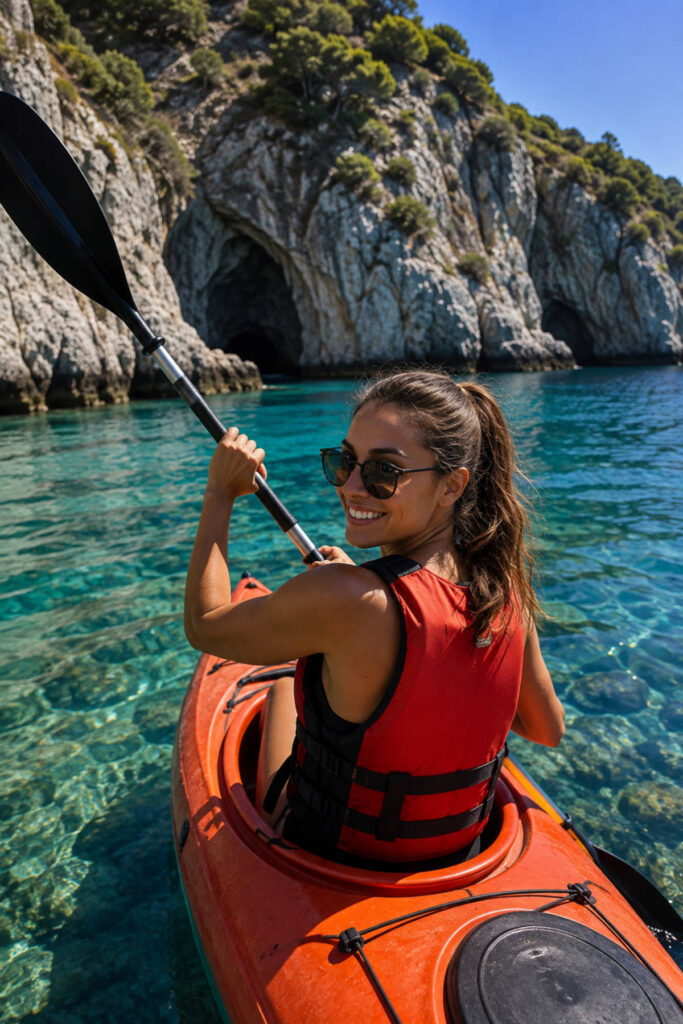
Footwear should stay securely on your feet and provide enough protection for walking over wet stones, gravel and uneven ground. Depending on the environment, suitable water shoes, paddling shoes or lightweight neoprene footwear can all make sense, while loose flip-flops are generally a poor choice because they offer little grip and can disappear into the river surprisingly easily. If your trip involves camping, carrying a separate pair of dry shoes for the evening can be one of those small decisions that becomes much more valuable after a long day on the water.
Hands present a slightly different problem because there is no single answer that works for every paddler. Some people prefer bare hands because they want maximum contact with the paddle, while others find that paddling gloves reduce friction and help protect against blisters during long days. Whatever you choose, it is worth testing the combination of gloves and paddle before the trip rather than discovering halfway down the river that something rubs in exactly the wrong place. A minor irritation after twenty minutes can become a painful problem after several hours of repetitive movement.
6. Food, Water and the Reality of a Long Day on the Water
Kayaking can be much more physically demanding than it appears from the shore. Even on calm water, you are repeatedly working your shoulders, arms, back and core, while wind and current can turn an easy-looking section into a sustained workout. That means hydration should be treated as part of the equipment you need rather than something you think about only when you become thirsty. Your drinking water needs to be accessible while paddling, securely stored and sufficient for the conditions and duration of the trip.
Food should follow the same practical logic. A complicated lunch that requires several utensils, careful preparation and a stable table is not particularly useful when you are sitting in a kayak or stopping briefly on a rocky shore. Compact foods that provide plenty of energy and can tolerate being carried in a dry bag are usually much more convenient, especially when the weather makes an elaborate meal unrealistic. Snacks are particularly useful because they allow you to eat small amounts throughout the day instead of waiting until you are exhausted before stopping for a proper meal.
On an overnight journey, food planning becomes a much larger part of the adventure. Everything has to be transported, protected from water and eventually packed out again, so weight and volume suddenly matter much more than they would on an ordinary camping trip. Before setting off, work out where you can refill drinking water and whether there are reliable sources along the route rather than assuming that every river, lake or stream is safe to drink from. Water may look perfectly clean while still requiring treatment before it is suitable for drinking.
There is something satisfying about the simplicity of eating on a long paddling trip. After several hours of moving across the water, even a basic sandwich or a warm drink at a quiet landing spot can feel like a proper meal. The point is not to recreate a kitchen inside your kayak, but to carry enough food and water to keep yourself comfortable, alert and capable of continuing the journey. Once again, the best equipment is often the equipment you barely notice because it simply does its job.
7. Sun Protection Matters More Than You Think
A day on the water can expose you to considerably more sunlight than you expect, particularly when there is little shade and the surface around you is reflecting light back toward your face and body. It is easy to underestimate this effect because moving air can make a warm day feel pleasantly cool while you are paddling. By the time you notice that your skin is burning, you may already have spent several hours outside. Sun protection should therefore be part of your normal paddling routine rather than something you remember only on exceptionally hot days.
Sunscreen is important, but it is not the only solution. A lightweight shirt with good coverage can protect your shoulders and arms without making you uncomfortably hot, while a hat that stays securely on your head is far more useful than one that disappears with the first strong gust of wind. Sunglasses are equally important because glare from the water can become tiring over a long day, especially when you are constantly looking toward the surface. Choose equipment that fits securely rather than relying on something that works only while you are standing still on shore.
There is another reason to think about the sun when packing for a kayaking trip: water makes ordinary mistakes harder to correct. You cannot simply walk into the nearest shop because you forgot sunscreen, and a forgotten hat may be particularly difficult to replace once you are several hours into a remote route. A few simple preparations before launching can save you from spending the rest of the day trying to hide your face under a piece of clothing. On a long trip, these small decisions add up to a much more comfortable experience.
8. Bring the Small Safety Equipment You Hope You Never Need
Kayaking is generally an accessible outdoor activity, but the water deserves respect even when conditions appear calm. A properly fitted personal flotation device is fundamental, and it should be worn whenever the conditions and local rules require it rather than being treated as something that can be kept nearby just in case. Depending on the type of water and the difficulty of the route, additional safety equipment may be necessary, particularly for coastal journeys, moving water or remote areas. If you are joining an organized trip, follow the equipment requirements and instructions provided by the operator or instructor.
A whistle is a remarkably simple example of useful safety equipment because it weighs almost nothing and can be heard much farther than a human voice. A small first-aid kit can also be valuable, particularly on longer journeys where a minor cut, blister or other problem may become increasingly irritating as the day continues. Navigation deserves similar attention: even if you expect to follow a familiar route, having a reliable way to determine your position can become important if visibility changes, weather moves in or you accidentally take the wrong channel. The goal is not to turn a recreational paddle into a military expedition, but to have sensible answers to problems that are unlikely but entirely possible.
Communication equipment should be considered according to the environment rather than the convenience of your everyday phone. In areas with reliable mobile coverage, a phone stored securely in waterproof protection may be sufficient for many recreational trips. Remote coastal or wilderness journeys can require more specialized communication and emergency equipment, and this is one situation where local knowledge matters enormously. If you are traveling far from help, ask an experienced operator what they consider appropriate instead of assuming that the same preparation that works on a nearby lake will work several hours offshore.
Most importantly, safety begins before you launch. Tell someone where you are going, understand the route and check the conditions rather than relying entirely on the fact that other people have paddled there before. If the weather changes or the water becomes more difficult than expected, turning around is not a failure and neither is ending the trip early. Good paddlers know that the purpose of safety equipment is not to give them permission to ignore risk, but to give them a better margin for dealing with the unexpected.
9. What Should Stay on Shore
One of the easiest ways to make a kayaking trip uncomfortable is to bring too much. Space inside a kayak is limited, and every unnecessary object competes with the things that actually matter while also adding weight to the boat. A bulky suitcase, several changes of unnecessary clothing or equipment that cannot tolerate water will quickly become more trouble than they are worth. Kayaking has a natural way of teaching you that owning something and needing it are two very different things.
Fragile electronics deserve particular skepticism. A camera may seem like an essential part of the trip, but if you spend the entire day worrying about whether it will survive the next splash, it is probably not helping you enjoy the journey. The same applies to laptops, tablets and anything else designed primarily for life on dry land. Unless there is a genuine reason to bring them, leaving expensive electronics at home means one less thing to protect and one less reason to spend the trip worrying about what might happen if the kayak tips.
Heavy cooking equipment, large coolers and oversized camping furniture can also be surprisingly impractical for a paddling journey. On a car camping trip, an extra chair or a large box of food may not matter much, but on a kayak every additional kilogram has to fit through a hatch and eventually be moved by hand. If you are traveling with a group, shared equipment is usually a much better solution than having every paddler carry a complete duplicate set. Before leaving home, look at each item and ask a simple question: will this genuinely improve the trip enough to justify the space it occupies?
There is a particular freedom in discovering how little you actually need on the water. Once the unnecessary things are gone, packing becomes easier, the kayak feels less cluttered and you spend less time thinking about your belongings. The river, lake or coastline becomes the focus again, which is exactly how it should be. A good paddling trip is not a competition to see how much equipment you can transport; it is an opportunity to travel lightly through a landscape that looks very different when you experience it from the water.
10. The Best Thing You Can Bring Is Good Judgment
After all the discussion about clothing, dry bags, food and equipment, it is easy to lose sight of the most important part of preparing for a kayaking trip: knowing your own limits. The right equipment can make a journey safer and more comfortable, but it cannot compensate for poor decisions, lack of experience or conditions that are beyond your ability. Water can change quickly, and the fact that a route looks beautiful and peaceful in photographs says very little about how demanding it may become in wind, waves or strong current. Preparation should therefore begin with an honest assessment of the trip and your own experience.
For beginners, a calm lake or sheltered section of river with an experienced instructor can be a far better introduction than immediately choosing a difficult route because it looks more adventurous. You have plenty of time to develop skills, learn how your kayak behaves and become comfortable with wet exits, basic rescue techniques and changing conditions. There is no particular achievement in discovering your limits at the worst possible moment. The most experienced paddlers I have encountered tend to be the people who understand that turning around can sometimes be the smartest decision of the entire day.
That is ultimately what makes packing for kayaking different from simply preparing a bag for a weekend away. Every item has a practical purpose, but the equipment only works properly when it is combined with preparation, awareness and respect for the environment. Keep your essential belongings dry, dress for the water rather than just the air temperature, carry enough food and water, and make sure your safety equipment matches the conditions. Then leave the rest behind and give yourself the freedom to concentrate on the experience.
There is something special about moving through a landscape under your own power, with the rhythm of the paddle replacing the noise of an engine. A shoreline that might look ordinary from a road can become completely different when you approach it from the water, while small coves, islands and stretches of wilderness suddenly become accessible without a trail or a road. Pack carefully, travel lightly and respect the water, and the kayak becomes more than a boat. It becomes a wonderfully simple way of seeing places that are impossible to experience from land.
The point about treating the kayak like a backpack rather than a car really makes sense. I used to pack way too much on short trips, and then spent half the day trying to find things through the hatch. Now I keep everything in small dry bags and it makes a huge difference.
Definitely agree about dry bags. I learned that lesson the hard way when my kayak tipped on a lake. My “waterproof” backpack wasn’t nearly as waterproof as I thought it was. Luckily my spare clothes were in a proper dry bag.
The clothing advice is probably the part beginners underestimate most. A sunny day doesn’t necessarily mean you can dress for warm weather, especially with cold water. I’ve had a couple of paddles where the air felt great but the water was absolutely freezing.
One thing I’d add is to listen to the person who knows the local water. Forecasts don’t always tell you what happens around a particular coastline or river section. Wind can be completely different once you’re actually out there.
The small stuff matters too. Sunglasses, sunscreen, a decent hat and somewhere secure for your phone sound boring until you’ve been on the water for four hours. I always think I won’t need sunscreen because of the breeze, and then regret it later.